How AI is driving innovation in discovery science and healthcare
And the policy steps that experts say would help innovation infrastructure advance at the pace of the technology.
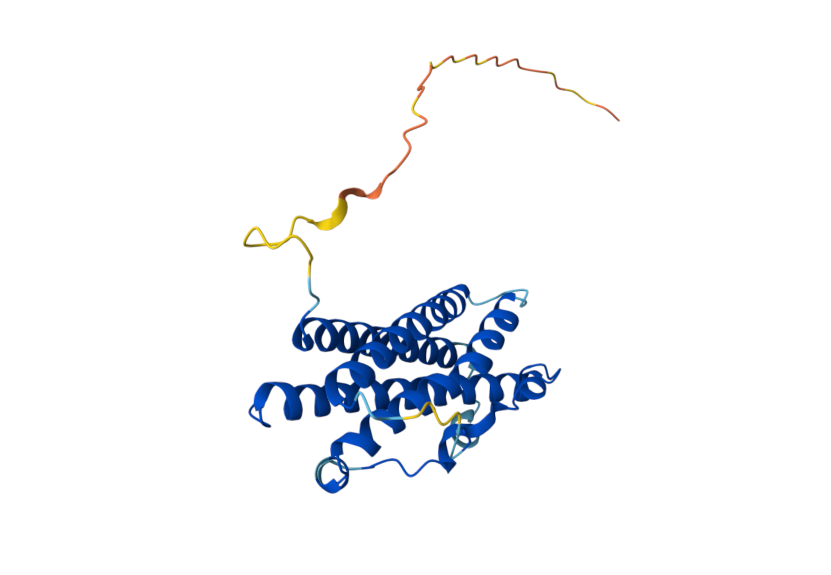
Sources: Jumper, J et al. Highly accurate protein structure prediction with AlphaFold. Nature (2021)
Bertoni D. et al. AlphaFold Protein Structure Database 2025: a redesigned interface and updated structural coverage, Nucleic Acids Research, (2025)
From forensic analysis to disease detection, AI is changing the way different sectors collect, process, and draw conclusions from information. As a result, human workers are focusing on different tasks, making new connections between data, and working faster than before.
At the recent Leading with AI summit hosted by the Johns Hopkins Carey Business School Technology and Society Initiative at the Hopkins Bloomberg Center, industry executives, think tank experts, researchers, and others working on AI innovation discussed how the technology is poised to redefine how scientific research and discovery happens and how healthcare is delivered. Despite recent progress, experts say policy must keep up with the pace of AI development to sustain innovation and responsible growth.
How AI is changing scientific R&D
AI is already transforming the way scientists work. Ryan Hill, assistant professor of strategy at Northwestern Kellogg School of Management, shared research showing how experimental structure biologists have responded to a new AI tool called AlphaFold.
AlphaFold can predict how a one-dimensional string of amino acids folds into a 3D protein, something scientists had struggled to solve for 50 years. It has successfully predicted the structures of nearly all of the 200 million proteins scientists have discovered, an advancement that could significantly accelerate drug R&D.
Experimental structural biologists once did what AlphaFold now does, leading Hill to wonder if the new technology had replaced scientists. After examining several leading scientific publications, he concluded that AI had changed—not eliminated—the role of experimental structural biologists.

“Experimentalists are starting to shift their work towards proteins or compounds or complexes of proteins that AI is slightly less capable at,” he said. AlphaFold, he added, complemented their efforts, making them faster and more efficient.
Jenn Gustetic, the director of metascience and R&D policy at the Institute for Progress, presented research showing how scientists across fields are adopting AI. One assessment, which analyzed 41 million research papers across six natural science fields, revealed a distinct trade-off. Scientists who “engage in AI-augmented research” publish three times as much as researchers who do not and are cited five times as often. But AI use limited the “collective volume” of topics studied and scientists’ collaboration with each other.
“If the goal is to try to stimulate novelty … because that’s where a lot of the innovation upside is, some of this evidence is showing that that’s not necessarily the direction that we’re seeing,” she said.
How AI is redefining healthcare delivery
While AI scribes and surgical assistance tech are already making their way to the clinic, experts say there are still many ways AI can continue to advance healthcare. Emily Boss, health policy and management professor at the Johns Hopkins Bloomberg School of Public Health, even believes AI will “humanize healthcare.”
Symptom research. It’s becoming more common for patients to consult AI chatbots about their symptoms or have them prepare a list of questions for a doctor’s appointment. Some say this is similar to patients Googling their symptoms. The real concern is the patient who doesn’t come in for a check up at all, said Ziad Obermeyer, co-founder of Dandelion Health, a company that provides de-identified patient medical data to help others build AI clinical tools.
Obermeyer also pointed out that the data AI chatbots use to respond to people’s symptom inquiries isn’t based on real medical records or patient data. Rather, it’s based on hypothetical vignettes fed to the model.
“I think where the real gap is, is the lack of evaluation on real data, and I think part of that comes back to … how hard it is to get access to real patient data,” Obermeyer said. “I definitely think that that’s one of the reasons we’re still very much in the dark about how these things would perform.”
Diagnosis. A challenge doctors have long dealt with is whether and when to test a patient for a potential health issue. The tension lies in either ordering a test that can be invasive, risky, or expensive for the patient just for it to come back negative, or deciding not to test a patient and missing a major health problem.
“I think that this overutilization-underutilization dilemma is really one of the first-order impacts that machine learning is going to have on the health system,” Obermeyer said.

Assisting, not replacing, healthcare workers. In the near term, AI tools will still require human collaboration and decision-making, as their models are trained on doctor diagnoses that aren’t 100% accurate.
“We know how to write code. We know how to do math. Medicine, we do not have figured out,” Obermeyer said. “We do not have this figured out, and AI is not going to figure this out for us because we don’t have that in the training data.”
In the short-term, AI may be able to execute on systems that are completely understood and documented. In other instances with data gaps, progress will come more slowly and involve more human-AI collaboration.
“There’s a huge amount of progress that we need to make in improving the science of medicine around all these things that are either not written down or written down wrong,” Obermeyer added. “So I think that there is a clear human role here in upgrading our system, rather than just replicating the same system that we already have, which is what you get with an AI tool that’s trained on yesterday’s data.”
However, Zachary Lipton, assistant professor at Carnegie Mellon University and co-founder of AI-scribe tool Abridge, predicts that more sweeping changes to healthcare will happen outside of the U.S. With less access to professional training and a different regulatory environment, some countries, he said, “will make much, much, much bolder bets on more fully autonomous healthcare systems.”
How policy can help sustain AI innovation
AI leaders and researchers are also considering how innovation infrastructure needs to change to keep up with an evolving AI ecosystem. Charles Yang, an AI for science fellow at Renaissance Philanthropy, argued that the federal government should invest in infrastructure capable of testing out hypotheses developed by AI. He compared his proposal to government supercomputers that catalyzed innovations in the private sector.
Adam Jaffe, professor emeritus of economics at Brandeis University, urged the U.S. Patent and Trademark Office to develop a clear policy for AI-generated inventions.
“To the extent that AI is being used in the invention process, is [that] we treat the AI like a calculator or a side rule or a microscope,” he said. “It’s just a tool that the humans use on the way to making this invention.” But, he added, that’s a “fuzzy distinction” that will grow less clear as AI becomes more powerful.