10 insights from the World Changing Ideas Summit
At the summit, hosted by Johns Hopkins University and Fast Company, leaders in health care, space, and AI shared their bold visions for the future.

In the current era of tech innovation, astronomy is helping oncologists map tumors. AI models are uncovering new possible antibiotics faster than ever. Advances in robotics are reshaping how we understand the brain.
Together, these breakthroughs are changing the way we live, work, and explore.
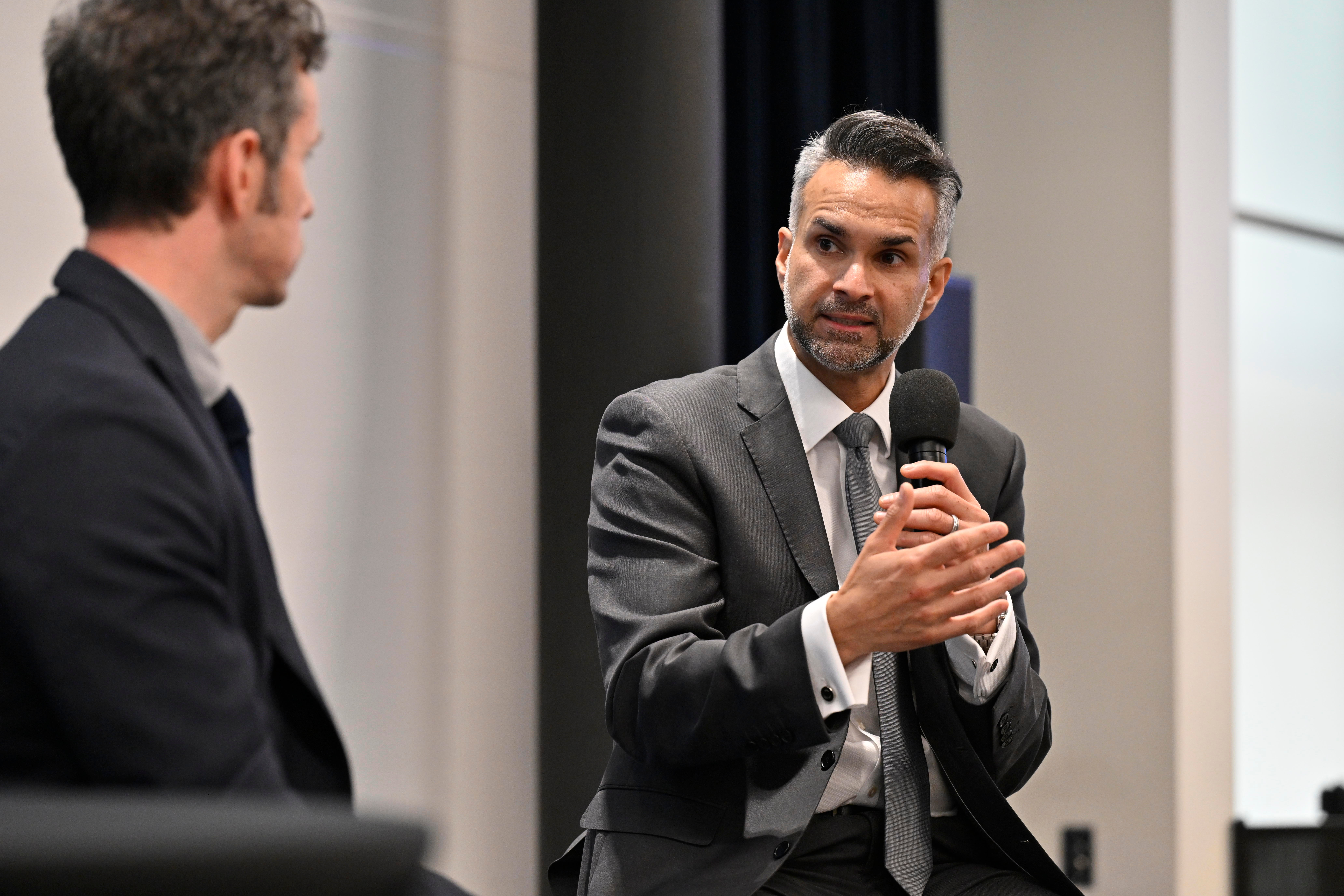
The inaugural World Changing Ideas Summit, hosted by Johns Hopkins University and Fast Company, brought these ideas—and the people behind them—together at the Johns Hopkins University Bloomberg Center in November. Here are 10 insights leaders shared at the summit.
On the power of collaboration in innovation
“Over the last several years, we [at Johns Hopkins] have birthed 130 new startups, including companies that have transformed our approach to early cancer detection and to the possibilities of regenerative medicine, to name but a few.
“This symbiotic relationship across research universities, government, and industry has propelled a range of extraordinary advancements—from the GPS that brought you here today… to the pacemaker and defibrillator… to asteroid-destroying spacecraft… to immunotherapies that have helped to reduce cancer mortality by 33% over three decades.”
– Ronald J. Daniels, president of Johns Hopkins University

On how space exploration improves life on Earth
“Probably the most common question we get in the space community is, ‘Why explore space? We have problems here.’ For me, it’s that we don’t know everything yet. … The technologies we develop to explore space help life on Earth, and we consistently are innovating and creating the future right in front of us.”
– Jack Kiraly, director of government relations at The Planetary Society

On using AI to discover new antibiotics
“With AI, we’re really accelerating the timeframes, the precision, and the scale of our work so that we can develop 15 novel antibiotics by 2030. This is a very ambitious goal, but we feel, based on all of our analysis, this is truly how we win the race [against antimicrobial resistance].”
– Akhila Kosaraju, president and CEO of Phare Bio

On the rapid advancement of AI and its unpredictable behavior
“Ten years ago, if you asked anyone in AI how long until the machines can talk as well as ChatGPT does today, some of these folks would have said anywhere from 50 years to it won’t happen.
“The future is very hard to predict, and a lot of the game of being a futurist, in some sense, is knowing which things are easy to predict and which things are hard to predict. As a mind of any sort becomes smarter, some aspects of it become easier to predict, some become harder. All of which is to say, if you’re playing chess against a computer, the better that computer is at chess, the harder it is to predict its exact moves, and the easier it is to predict it will win.”
– Nate Soares, president of the Machine Intelligence Research Institute and author of If Anyone Builds It, Everyone Dies

On the relationship between humans and AI in the physical world
“Now, the AI generates massive amounts of performance data, but it’s the humans who look at this evidence and make the go/no-go decision. So you might see a pattern here. AI is informing the choice, but the humans are making the assessment if the [Waymo] driver is ready for the public roads. So I think it’s a world of coexisting and leveraging the best of each other. ”
– Smitha Shyam, senior director of engineering at Waymo

On the accelerating shift to AI-driven scientific tools
“If an AI algorithm can drive our cars today, it should be driving our microscopes and telescopes tomorrow.”
– Alex Szalay, astrophysicist at AstroPath and director of the Institute for Data Intensive Science at Johns Hopkins

On the new space race for the next generation
“This generation is in a space race. It is not the same space race that our parents, our grandparents, had to contend with. This one is different because it’s about going to the moon and actually staying on the moon and using that for strategic and economic advantage.”
– Dennis Woodfork, mission area executive for National Security Space at the Johns Hopkins University Applied Physics Laboratory (APL)

On planetary defense and shared responsibility
“Asteroids don’t care which country you live in. They care which planet you live on, and that’s why international collaboration is critical for planetary defense.”
– Terik Daly, planetary scientist at APL

On the increased energy demand
“I always say we need an all-of-the-above approach. We can’t take kilowatts or electrons off the grid in a time of high demand. So we need everything, whether it’s wind, solar, gas, nuclear. All electrons are good electrons at this point if we’re going to focus on the affordability issue.”
– Calvin Butler, president and CEO of Exelon

On the near-term trajectory of space access
“I think in the next decade, [space tourism] will be much more accessible. I think in the next few years, let’s focus on making sure that the U.S. has a continuous, strong presence in space, and then we’ll build from there.”
– Saleem Miyan, CEO of Max Space