8 books Johns Hopkins experts recommend for policymakers right now
Pick up these titles to dive deeper into modern U.S. foreign economic policy, how public policy can support innovation ecosystems, the ethical implications of living in outer space, and more.
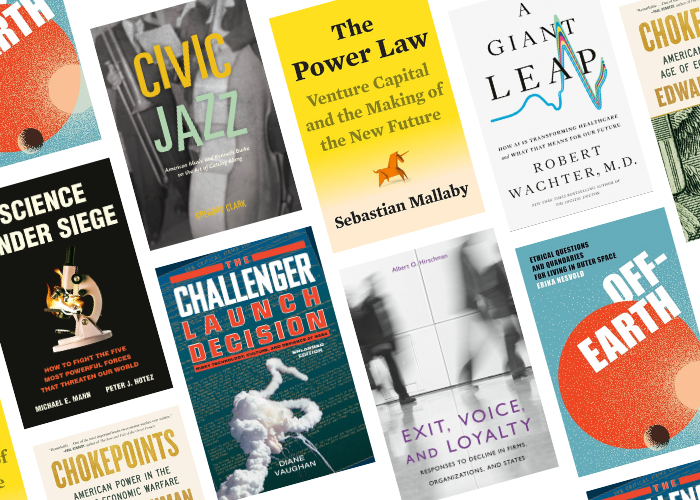
As the summer season kicks off, eight Johns Hopkins experts share the books they recommend for policymakers and leaders interested in exploring economics and modern geopolitics, the current state of science and AI in healthcare, institutional dynamics in times of pressure and instability, and more.
With an emphasis on historical deep dives and multidisciplinary perspectives, this book list includes a detailed account of how the U.S. has come to use economic chokepoints to wield geopolitical power, the ethical implications of living in outer space, and the lessons from jazz that can help strengthen civic life.

Civic Jazz: American Music and Kenneth Burke on the Art of Getting Along by Gregory Clark
As an associate professor of jazz at the Peabody Institute of The Johns Hopkins University and creator of Peabody’s Let’s Build Together initiative, Richard Johnson is interested in exploring how creativity can bring together different disciplines, perspectives, and communities.
Weaving political science with rhetorical communication, Civic Jazz showcases the role improvisation, listening, and collaboration play within both music and democratic society.
“After leading a recent workshop on the role of AI in Latin American jazz and Afro-diasporic musical traditions,” Johnson said, “this book also reinforced my belief that innovation and technology are most meaningful when they remain grounded in human connection, communication, and collective creativity.”
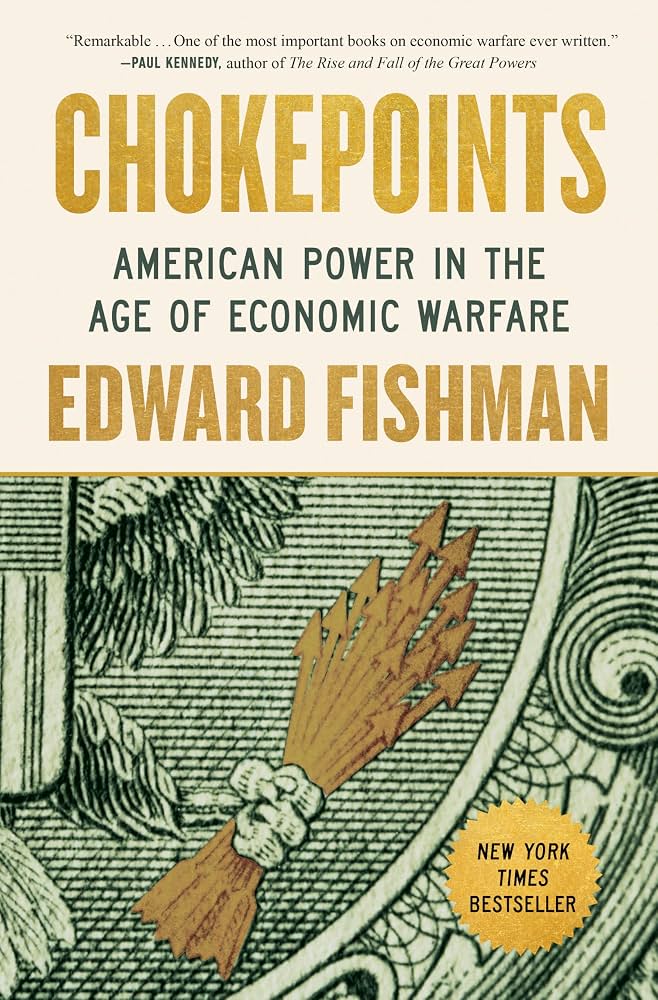
Chokepoints: American Power in the Age of Economic Warfare by Edward Fishman
For anyone who read Henry Farrell and Abraham Newman’s Underground Empire—still the definitive account of how the United States quietly built the infrastructure of weaponized interdependence—Edward Fishman’s book is the essential next read, according to Matthias Matthijs, Dean Acheson associate professor of international political economy at the Johns Hopkins University School of Advanced International Studies.
Where Farrell and Newman map the system, Fishman, a former State Department sanctions official, takes readers inside the rooms where it has been wielded, offering the most accessible and authoritative account yet of how dollar clearing, semiconductor supply chains, SWIFT, and export controls became day-to-day instruments of American statecraft.
“For a policymaker audience, the book is essential not because it celebrates this toolkit but because it shows how quickly it has become the default reflex of American foreign economic policy, often outrunning any clear strategy about when and how it should be used,” Matthijs said. “As the Trump administration leans even harder on tariffs, secondary sanctions, and ‘pay-to-play’ deals with individual firms, Fishman’s history helps explain both how we got here and what is at stake when the United States shifts from umpire to player in the rules-based system it built.”
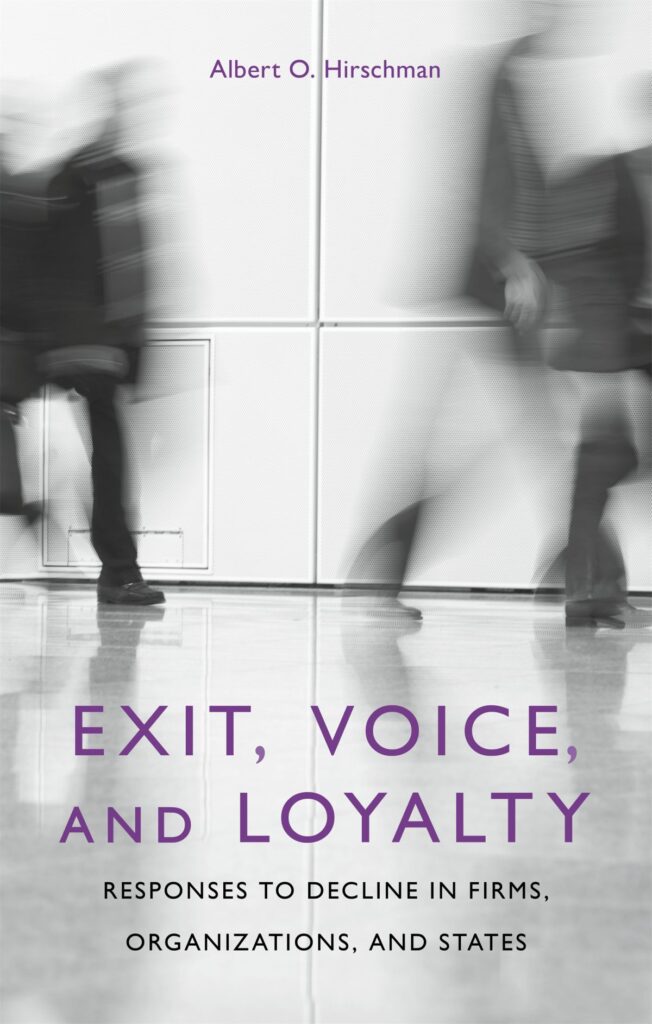
Exit, Voice, and Loyalty: Responses to Decline in Firms, Organizations, and States by Albert O. Hirschman
Though it’s a short read, this 1972 book can be a useful tool for policymakers, according to Tinglong Dai, Bernard T. Ferrari Professor at the Johns Hopkins Carey Business School.
Albert Hirschman asks a simple question: When an organization, institution, firm, or country starts to decline, what do people do? They can leave, or they can speak up. Loyalty shapes that choice: It can keep people from walking away too quickly and give reform from within a chance. From that simple framework, Hirschman builds a way of thinking that applies almost everywhere: hospitals, universities, public agencies, political parties, cities, labor markets, and democracies.
“It is one of those books that gives you language for things you have always noticed but never quite named,” Dai said. “After reading Hirschman, you start seeing exit, voice, and loyalty everywhere in your life. You just can’t unsee it.”

The Power Law: Venture Capital and the Making of the New Future by Sebastian Mallaby
In The Power Law, Sebastian Mallaby traces the evolution of venture capital and its outsized role in shaping modern innovation, offering policymakers an accessible look at the mechanisms that convert innovation into economic growth and societal change.
Through profiles of influential investors and iconic companies, he explains how the venture model evolved to identify, fund, and accelerate transformative technologies despite high levels of uncertainty and failure. The book highlights how capital allocation influences which ideas flourish and which never leave the drawing board.
“The Power Law gives a behind-the-scenes look at the role of venture capital in translating ideas into industries, explaining why some regions become innovation hubs while others struggle to scale new technologies,” said Christy Wyskiel, senior advisor to the president of Johns Hopkins University for innovation and entrepreneurship and executive director of Johns Hopkins Technology Ventures. “It provides understanding about how innovation ecosystems function and how public policy can support competitiveness.”
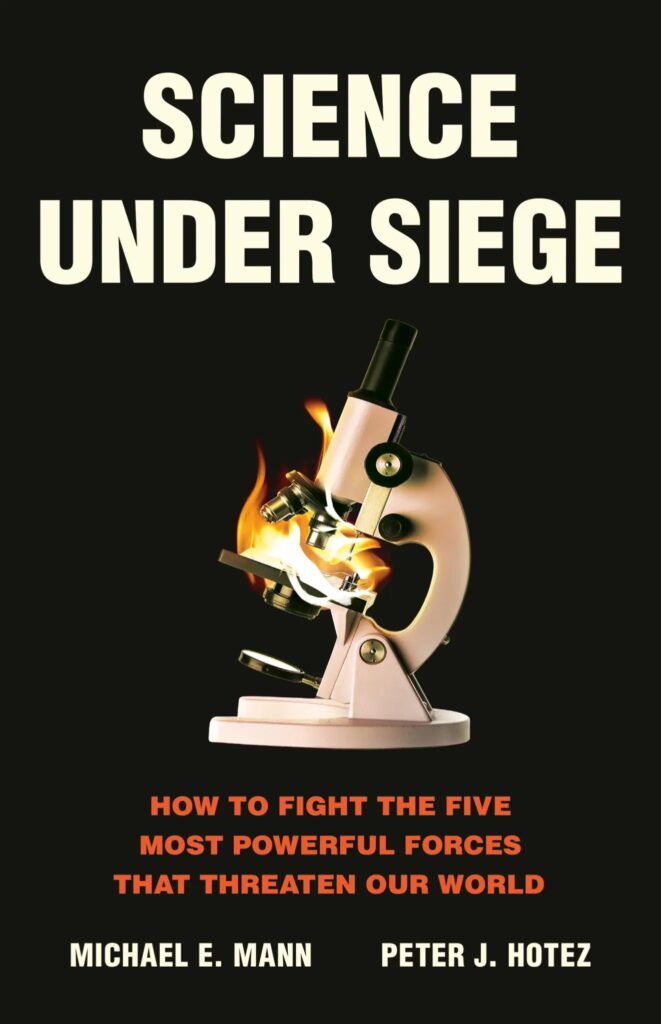
Science Under Siege: How to Fight the Five Most Powerful Forces that Threaten Our World by Michael E. Mann and Peter J. Hotez
Gigi Kwik Gronvall, immunologist and associate professor in the Department of Environmental Health and Engineering at the Bloomberg School of Public Health, recommends this book for people outside of health and climate fields who want to understand politically and ideologically motivated opposition to science—and some ways to respond.
“Science and technology have given us amazing things, with much more on the horizon—new cures for previously incurable diseases, new ways to turn the effects of climate change around, new ways to feed everyone on the planet—but none of that can happen when there are such strong antiscience forces derailing progress and going after the scientists themselves,” Gronvall said.
The book, written by two respected and well-known scientists, outlines five main forces threatening science and argues why the rise of antiscience is dangerous to our collective future.
“This will be a generational problem that is necessary to tackle for all of our sakes,” Gronvall said.

Off-Earth: Ethical Questions and Quandaries for Living in Outer Space by Erika Nesvold
As nations race to return to the moon with plans on making humans a multiplanetary species, Erika Nesvold speaks to experts from across disciplines to explore the ethical questions and potential pitfalls of doing so, including labor rights, environmental, and medical considerations.
“Dr. Nesvold pairs a clear and deep love of the cosmos with an equally deep sense of what it means to be a human, for better and for worse,” said Sarah Hörst, professor in the Morton K. Blaustein Department of Earth & Planetary Sciences. “She is therefore the perfect person to explore many of the questions often left unspoken when discussing humankind’s expansion into the solar system.”

The Challenger Launch Decision: Risky Technology, Culture, and Deviance at NASA by Diane Vaughan
In The Challenger Launch Decision, Diane Vaughan uses the accounts of managers and engineers to recreate the steps leading up to the Space Shuttle Challenger explosion in 1986. Instead of being caused by “deviant” individuals, Vaughan shows that the Challenger disaster was produced by a complex organization operating under profound stress.
“[The book] is one of the most remarkable pieces of social science I have ever read,” said Steven Teles, political science professor at the Johns Hopkins Krieger School of Arts and Sciences. “An organizational and cultural sociologist, Vaughan took on the daunting task of understanding the very technical engineering details of the Challenger disaster, while putting them in the context of a sophisticated understanding of how complex organizations behave. The payoff is a complete reinterpretation of a set of events that everyone thought they understood.”
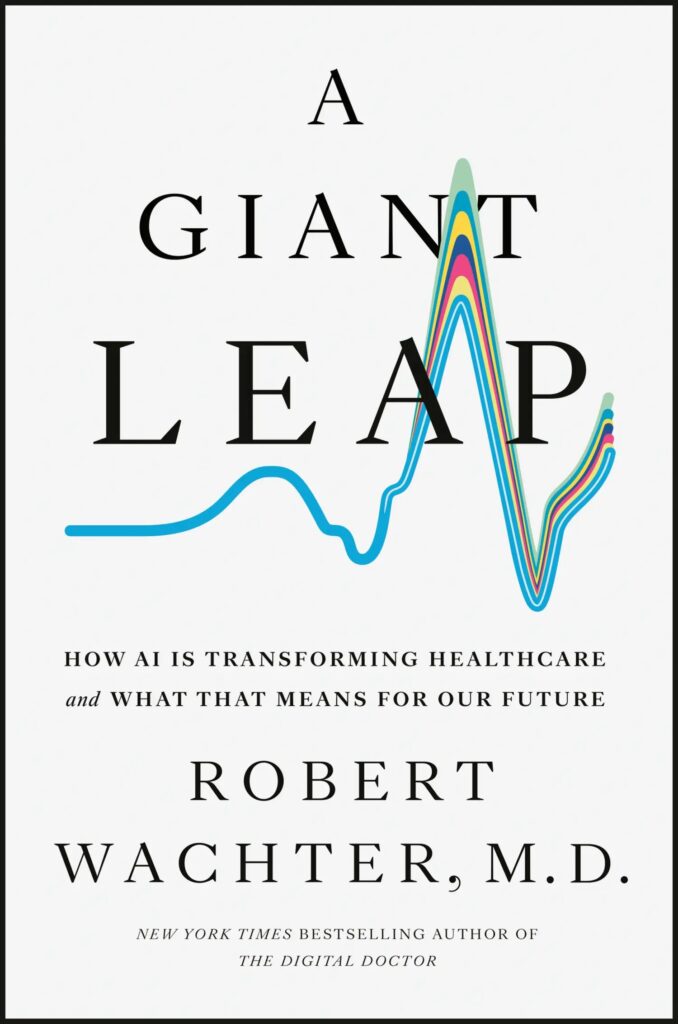
A Giant Leap: How AI is Transforming Healthcare and What That Means for Our Future by Robert Wachter
The healthcare sector has an indisputable effect on society and the economy, as it’s central to both human flourishing and national prosperity. A Giant Leap is a timely treatise on how artificial intelligence is affecting healthcare ecosystem players—and importantly, patients and providers—offering a reflective, reasoned account of this digital transformation from the perspective of renowned clinician Robert Wachter. Peppered with many of his own lived experiences, this book is a refreshing read that helps dispel some of the fog in the AI-healthcare discourse, according to Ritu Agarwal, Wm. Polk Carey Distinguished Professor of information systems and health at the Johns Hopkins Carey Business School and founding co-director of the Center for Digital Health and Artificial Intelligence.
“With polarized perceptions on AI in healthcare spanning a range of emotions— enthusiasm, apprehension, optimism, and anxiety—Wachter reminds us of the value that AI can create in this critical domain for value and cost,” Agarwal said. “But equally, he draws attention to inherent risks in algorithmic healthcare that must be carefully managed.”