What to read after seeing “Ceremony” at the Frary Gallery
A reading list to help you dive deeper into the themes of Lindsay Adams’ exhibition.

In the Irene and Richard Frary Gallery’s first solo exhibition, Ceremony, award-winning artist Lindsay Adams uses gestural brushstrokes and abstract landscapes to reflect and explore the histories of Black movement, migration, and world-building. Guest curated by Claudia M. Watts, Ceremony pairs rare archival materials from Johns Hopkins Sheridan Libraries to place Adams’ works in historical context and show the people and histories that inspire her art.
To help visitors further explore the exhibition’s themes, Adams and Watts share a handful of books, poems, and essays that highlight the key figures featured in Ceremony as well as histories of Black mobility, belonging, and creativity.
As told to the Hopkins Bloomberg Center. Lightly edited for clarity and brevity.

The Negro Motorist Green Book by Victor Hugo Green
The Negro Motorist Green Book, published annually from 1936–1967, was an essential travel guide for Black Americans during the Jim Crow era, mapping a network of safe sites—restaurants, gas stations, and lodgings—that enabled mobility, belonging, and collective care. As scholars Gretchen Sorin and Candacy Taylor have noted, the Green Book shaped how Black travelers experienced place through movement, improvisation, and relational knowledge, producing a geography defined as much by absence and precarity as by refuge.
In Ceremony, these sites inform Adams’ temporal landscapes, where the endurance, erasure, and afterlives of Black spatial networks are reimagined as acts of memory, continuity, and world-making, or producing new ways of being that are independent of harmful dominant portrayals.

Driving While Black: African American Travel and the Road to Civil Rights by Gretchen Sorin
In Driving While Black: African American Travel and the Road to Civil Rights, Gretchen Sorin examines how mobility and access to safe travel shaped Black freedom under Jim Crow, revealing the systematic racialization of space and movement. Drawing on archival research and oral history, she shows how the automobile, Black-owned businesses, and networks of Green Book sites functioned as tools of survival, agency, and spatial resistance. Sorin’s work provides a framework for understanding how historical conditions of Black travel shape fluid, relational, and continually reimagined forms of belonging, informing Adams’ engagement with displaced and historical Black geographies.
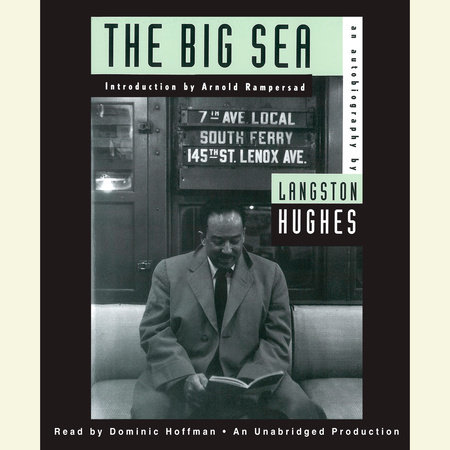
The Big Sea by Langston Hughes
If the automobile transformed mobility throughout the country, movement abroad presented a mythical freedom. Traveling across the ocean in search of greater opportunities, artists, writers, and entertainers like Langston Hughes, Josephine Baker, Billie Holiday, and countless others landed in Paris. Although they still encountered racism, it was to a less suffocating degree. Adams’ Errantry/Exodus, 2025, with its primary use of green and wavelike gestures, is a visual response to Hughes’ first autobiographical novel, The Big Sea, and the green ink he often used for his signature.
In The Big Sea, originally published in 1940, Hughes traces his coming of age as a Black writer during the Harlem Renaissance while mapping broader geographies of Black life across the U.S., the Caribbean, and Africa. Hughes frames movement, both physical and social, as central to Black artistic formation, emphasizing travel, labor, displacement, and creative community. The memoir offers a spatial and relational understanding of creativity, showing how mobility, observation, and cultural exchange shape practices of imagination and world-making.

The Ceremony Found: Towards the Autopoetic Turn/Overturn, Its Autonomy of Human Agency and Extraterritoriality of (Self-)Cognition by Sylvia Wynter
The stories from Hughes’ The Big Sea, represented through archival objects and expressed with Adams’ painterly technique in Ceremony, demonstrate alternatives to a circumscribed identity and quality of life. They point toward a newly formed consciousness of the intrinsic value we possess as people, despite any worldly restrictions or categorizations.
It is in this spirit that Adams chose to invoke Sylvia Wynter’s essay, The Ceremony Found: Towards the Autopoetic Turn/Overturn, Its Autonomy of Human Agency and Extraterritoriality of (Self-)Cognition. In this text, Wynter’s words speak to the power of narrative and remind us that if certain mythologies exist to tell the world who we are, they also exist to keep us trapped within the status quo. For Wynter, the ceremony is where we find freedom by recognizing the many modes of human existence, bringing them into a nonhierarchical relation with one another, and remaking ourselves in that image. Adams’ Ceremony offers entry into this line of thinking. The ideas and experiences presented are a testament to the transformative power of community.

The Weary Blues by Langston Hughes
In The Weary Blues, Hughes integrates the structure and vernacular of blues music to portray Black interiority through rhythm, repetition, and sound. The poem presents performance as an embodied and spatial practice, transforming exhaustion and longing into expressive form. By collapsing the boundaries between music and poetry, Hughes positions the blues as a site of imagination, endurance, and quiet resistance within constrained social conditions.
Hughes is one of many notable figures whose work and personal correspondence are displayed alongside Adams’ work in Ceremony. These archival pieces offer insight into the people engaged in both creative pursuits and the plight for freedom and equality.

Black in Blues: How a Color Tells the Story of My People by Imani Perry
In Black in Blues, Imani Perry traces the cultural, historical, and emotional significance of the color blue in Black life, connecting music, art, ritual, and material culture across time. She frames blue as both metaphor and archive, revealing how aesthetics and affect preserve memory, resilience, and expressions of Black identity. Perry’s work provides a lens for understanding how embodied practices and cultural forms create relational and imaginative spaces, informing approaches to memory, belonging, and world-making in Black spaces and places.

Black Gathering: Art, Ecology, Ungiven Life by Sarah Jane Cervenak
Using various artworks and literary examples, Sarah Jane Cervenak’s framework seeks to dispel Enlightenment ideologies that assign African American existence to perpetual ownership or an assumed givenness. Gathering, physically and conceptually, becomes an act not only of survival, but of cultural preservation meant to withstand imposed forms of erasure. At its core, Black Gathering explores how community, in its many facets, can facilitate life beyond the broader social structures that inflict violence upon the other.
In this sense, Ceremony is a fragmented collection of stories in which Adams’ canvases represent the gathering of ideas, moments, values, and desires. The archival materials featured in the exhibition are both symbols of the concepts that Adams engages with and remnants of real lives. Together, they celebrate and illuminate the ways African Americans have navigated their surroundings in an effort to cultivate spaces of safety, creativity, respite, and economic access. With an emphasis on spatial refusal and world-building, the exhibition focuses on three thematic groupings: travel, which is split into two sections, domestic and international; social life and collective uplift; and leisure and interiority.

The Land Was Ours: How Black Beaches Became White Wealth in the Coastal South by Andrew W. Kahrl
Andrew Kahrl’s book traces how Black-owned leisure properties along the coast were lost to legal manipulation, environmental policy, and development interests. These sites, once central to Black refuge, became temporal landscapes, disappearing as integration progressed.
The Land Was Ours underscores a central concern of Adams’ research: that even as Black spaces are physically erased, their meaning persists through memory, imagination, and artistic recovery. His work reinforces Adams’ argument that belonging is not tied to permanence but emerges through layered and resilient forms of spatial practice people exercise in their day-to-day lives.

In the Wake: On Blackness and Being by Christina Sharpe
In In the Wake: On Blackness and Being, Christina Sharpe introduces the concept of “wake work” to examine the enduring afterlives of slavery and the conditions that shape Black existence. Sharpe theorizes the wake as both a physical and metaphorical space where loss, mourning, survival, and the future coexist, using personal narrative and archival fragments to read rupture and erasure.
This framework informs Adams’ practice by grounding her engagement with lost and displaced Black geographies, positioning artistic mark-making, memory, and imagination as forms of wake work that sustain belonging and allow for reimagined futures beyond material absence.
Billie Holiday and Josephine Baker collections at the Johns Hopkins Sheridan Libraries
For an immersive experience, visit the Johns Hopkins Sheridan Libraries to explore its special collections on Billie Holiday and Josephine Baker, who are prominently featured in Ceremony.
The Billie Holiday collection, which includes materials assembled by the libraries’ curators, contains letters, articles about Holiday, photographs, and more created by and about Holiday during her lifetime and after she died in 1959. Through books, promotional flyers, and black-and-white photographs, the Josephine Baker collection documents every decade of Baker’s career—on stage, in film, in cabarets, in concert, in recording studios, on radio, and on TV.