How the U.S. can maintain biotech leadership
Sens. Alex Padilla and Todd Young share their bipartisan work on U.S. security amid rapid biotech advances and growing competition.
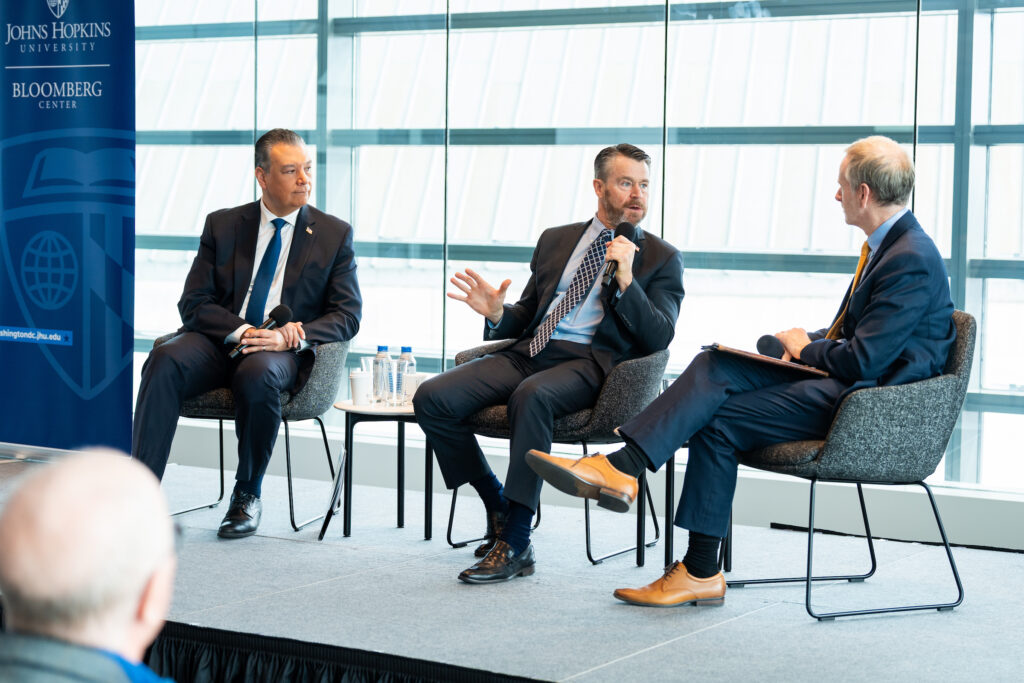
Sens. Alex Padilla (D-Calif.) and Todd Young (R-Ind.) didn’t sugarcoat the reality of growing competition in biotech. China is pulling ahead of the United States in the race to become the current biotech superpower, a shift they said that could affect sectors ranging from agriculture to defense.
“We’re seeing startup companies where they are first to the punch in order to come up with novel solutions to hard problems,” Young said at The Bridge, a series at the Johns Hopkins University Bloomberg Center focused on dialogue between bipartisan leaders who are working together on practical policy solutions. “And I only see that growing in the future, so we need to up our game and not underestimate.”
Biotechnology is the design and engineering of biological systems, which has a wide array of applications, from the development of mRNA technology for vaccines to bioremediation, which uses bacteria to remove pollutants from soil and water. The senators said the sector should carry the same national urgency as semiconductors and artificial intelligence, and the pair worked together on the National Security Commission on Emerging Biotechnology (NSCEB) to develop a strategy to ensure America leads the field in the future.
Here’s what they said about the importance of the biotech sector and the ways the U.S. can strengthen its leadership and national security as rapid advancements in biotech pose new opportunities and risks.
Talent is key to biotech leadership
Both Padilla and Young stressed that America will only unlock the full potential of biotech if it builds the right talent pool.
“There should be [biotech] core curriculum at every college and university for young people to start learning this as they’re obtaining their degrees before entering the workforce, so they come in with that capacity and ready to hit the ground running,” Padilla said. The California senator wasn’t just speaking of scientific and technical roles, but careers in government, as well.
“We don’t have the bioliteracy that we necessarily need across departments and across agencies to No. 1, get the urgency of this moment and No. 2, to inform our decisions, our policymaking,” Padilla added.
The structure of the federal government should support biotech prioritization
Besides talent, the two senators said they’re reforming government structures to ensure agencies understand the opportunities and threats of new biotech advancements.
The NSCEB, of which Young is the chair and Padilla is a commissioner, helped to establish a biotech office within the Pentagon, but that’s not enough, Young said.
“We need that within the office of the president,” Young said. “We need someone at the White House, across agencies, to own this portfolio and to see that we continue to drive these recommendations across the finish line [and] develop new recommendations as time plays out.”
This is key to ensuring that biotech remains a national priority even as leaders across the executive and legislative branches change over time, Padilla said. But government isn’t meant to achieve this alone, the senators pointed out.
“Partnerships are huge,” Padilla added. “The private sector, academia—that continues to be one of our national strengths and advantages globally.”
Biotech could enhance national defense
Technology, particularly AI, has created a “leap” in potential biotech applications, Padilla said. Historically, innovation in the sector has been heavily focused on pharmaceutical applications. Young shared one possible use case he’s tracking closely: powdered blood. A Marine Corps veteran, Young said that the U.S. has typically relied on extended supply chains to bring blood used for medical treatments to conflict areas. Powdered blood could be mixed with water and used to save lives.
“If you can give Marines blood out in the field off the shelf, ready to use,” he said, “we can make about anything in support of our war fighter.”