What’s on the horizon for space science and exploration in 2026
Johns Hopkins Applied Physics Lab space exploration sector head says this year will be ‘pivotal’ for U.S. space operations.
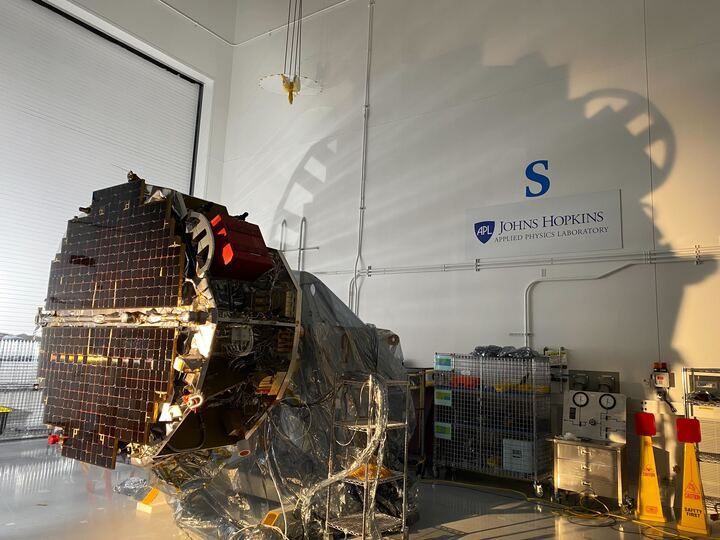
Last year was a “vibrant” year for space science and exploration, said Bobby Braun, head of the space exploration sector at the Johns Hopkins Applied Physics Laboratory (APL). 2025 saw a record number of global orbital launches at 324 attempts, up 25% from 2024. Last year, the space industry also laid the groundwork for NASA’s highly anticipated Artemis II launch in February. And it saw a renewed urgency for U.S. space leadership across government and industry, culminating in Congress passing a spending bill earlier this month that included a $24.4 billion NASA budget.
APL had its fair share of achievements in 2025, too, with the launch of four missions for NASA, including the Interstellar Mapping and Acceleration Probe (IMAP), which will study the solar wind and the heliosphere, or the shield around the solar system that protects our world from galactic cosmic radiation, and the Polylingual Experimental Terminal (PExT), a space technology demonstration that successfully connected a broad range of communication networks demonstrating a data-roaming capability in space, similar to cell phone roaming.
Now, as the space industry looks ahead, Braun shares the missions that may drive the sector in 2026, the most exciting technology developments on the horizon, and what policymakers should be paying attention to as the U.S. works to maintain space superiority.
Where do you think we’ll see the most focused investment in space, whether commercial or federal, in 2026?
With the recently passed FY2026 spending bills, all the planned science, technology, and exploration activities should go forward, including operations in space, around the sun with the Parker Solar Probe, and in the far reaches of our solar system like with the New Horizons spacecraft, which is out beyond Pluto in the Kuiper Belt, and Europa Clipper—the largest planetary science spacecraft ever built—which is headed towards Jupiter’s moon, Europa. I’m excited to see NASA launch the Nancy Grace Roman Space Telescope in 2026, too.
When it comes to new missions, APL will focus on Dragonfly. It’s maybe the most audacious planetary science mission of all time. In 2028, we’ll be sending a car-sized, nuclear-powered octocopter to Saturn’s moon, Titan, to search for the chemical building blocks of life. In 2026, the subsystems for Dragonfly will all start to come together here in Maryland, at APL, and also out in Colorado at our partner Lockheed Martin’s site, and we’ll start building up the hardware that will ultimately launch to Titan.
Decades in the making, Artemis II will no doubt be the major news story in early 2026. I couldn’t be more excited to see humans travel around the moon and farther from Earth than ever before. NASA is also gearing up for Artemis III, which will send humans back to the moon to explore its surface in 2028. In preparation for that, 2026 will see a series of robotic landings on the moon, which will deliver either science or technology payloads to build up the capabilities and infrastructure that humans may need when they land a few years later. Ultimately, I’d like to see the U.S. create a basecamp environment that humans could utilize to live, work, and play on the moon for longer periods of time in the future.
In 2026, I also think you’re going to see a greater focus on space weather prediction. Space weather can affect our entire society, and a space weather storm that is not known in advance can negatively impact our satellites and even our electrical grid, depending on which portion of the Earth is facing the direction of this high-energy radiation. Fortunately, we’re protected from a lot of space radiation by the Van Allen Belts, but when there’s a storm and the radiation levels are raised, some of it can get through. While this creates the beauty of the northern lights, there have been space weather events in the past that resulted in a loss of satellites or surface power infrastructure. Space weather prediction is a really important part of the work that we do at APL through missions like Thermosphere, Ionosphere, Mesosphere Energetics and Dynamics (TIMED), IMAP, and Electrojet Zeeman Imaging Explorer (EZIE).
As human and robotic activity beyond Earth’s orbit accelerates, what opportunities do you see for the next phase of U.S. space exploration?
Everything that we do in space builds on prior accomplishments. Each mission builds on the last. For example, there are future missions that will take the answers that Europa Clipper and Dragonfly provide and address more detailed questions that we haven’t yet asked. The communications technology from PExT is likely to be built into a wide set of missions in the future.
And if you think about human exploration, Artemis II will lead to Artemis III in 2028 and future human landings beyond 2028. Creating a base camp on the moon would be a great way to build capability that will lead to more extensive exploration of the moon in the future.
There is so much potential in the U.S. launch industry. 2026 should see several of these new systems come into operation. An increased launch cadence will enable significant advances in exploration, science, commerce, and national security.
What role do you expect AI to play in space science over the next year?
We’ve been using AI to analyze space science data sets. Whether you’re looking at the Earth, Mars, or the moon, space observation of these worlds has resulted in very large amounts of data—so much that it takes a long time to fully analyze this data with human eyes. This is a challenge tailor-made for AI.
The other big area for AI that is just starting to be discussed in the space community is the idea of in-space data centers. We fly computers in space all the time, and they’re getting more and more capable. It’s also relatively cold in space, and there’s a ready source of power from the sun. If you’re in a relatively cold environment and you have power and a good computer, you have a mini data center. Perhaps five to 10 years from now, I think there’s going to be constellations of spacecraft that are networked together communicating—passing data between themselves—and in a sense, forming a large, networked AI data center in space. I think the commercial space sector will lead those efforts.
What’s something on your radar that you think will be an exciting development or achievement for space science or exploration in 2026?
If I was making a list of things to watch for in 2026, Artemis II would be at the top of my list. The space community is united around this February launch. The buildup of the Dragonfly lander this year is also going to be amazing. On top of that, I think you’ll see continued growth in Earth-based networks of spacecraft. A few years ago, there was nothing called Starlink. Now we take it for granted that there are over 8,000 spacecraft in the Starlink constellation. The Chinese and the Europeans are building their own constellations similar to Starlink as well. Our society is going to be more and more dependent on space over time—not just for communications, navigation, and imagery like we are today, but ultimately for a broad range of services, including internet connectivity, compute capability, and eventually use of resources in space. Creation of these new economic enterprises is likely to expand in 2026.
“I think the Artemis II flight will bring space into the forefront like it hasn’t been in the last few years.”
– Bobby Braun, head of the space exploration sector at the Johns Hopkins Applied Physics Laboratory (APL)
What considerations are most important for ensuring that the U.S. has long-term stability and sustainability in space as activity increases?
First and foremost, space access. In the last few years, the U.S. industry has really built up a fantastic capability for low-cost and rapid access to space, and that’s what has enabled us to utilize space in new ways, whether it’s for science, exploration, commerce, or national security. So open access to space and lowering the cost of access to space are key.
Secondly, freedom in space, so space as a global commons—a democratic principle and policy position that the U.S. and our allies have assumed and enabled for many decades. In other words, any country or any organization that wants to move about in space, assuming that they don’t disrupt somebody else who’s already there, should have the right to move about freely. That’s led to the growth of space markets, that’s led to better utilization of space to help us all on Earth, and that’s led to significant advances in science and exploration. So, if you want to do more in space over time, maintaining that stable, open, and low-cost access to space, as well as the ability to move about in space freely, is very important.
What word or phrase do you predict we’ll use to define space science and exploration in 2026?
Pivotal. Primarily because a lot of things are going to happen in 2026 that will enable the future in space that many of us have dreamed about. You don’t have to look any further than Artemis II and its planned flight. It’s the first time in more than 50 years that we’ll have humans that far from Earth. That’s a generational thing. Regardless of whether you want to send people into low-Earth orbit for research reasons or for tourism reasons, whether you want to send humans to the moon, to Mars, or to explore an asteroid, the first step is returning to the moon.
I don’t remember the Apollo missions, but I know that there have been humans in space continuously for 25 years on the International Space Station. So when I look up at the night sky, I sometimes find the International Space Station as it flies over, and I know that there are people like me up there, and it affects the way I think about our society. It affects the way I think about the world and the way I think about our future. I’m really looking forward to being able to look up at the moon in the night sky and wave to those four brave Artemis II astronauts who are on that orbital flight around the moon. I think lots of people will. I think the Artemis II flight will bring space into the forefront like it hasn’t been in the last few years.
On top of that, there are many other activities in the space science and space technology domains that are poised to prove new capabilities or to answer age-old questions that are going to lead us into that space future. I think space will continue to inspire the world.