6 Hopkins innovations featured at the World Changing Ideas Summit
Johns Hopkins accomplishments showcased at the Fast Company event span health care, space exploration, and physical AI.
Transformational innovations aren’t always born in corporate boardrooms; many of them are conceived in university labs, as executive director of Johns Hopkins Technology Ventures Christy Wyskiel wrote in Fast Company recently. Universities, alongside private industry and the federal government, are a core pillar of American innovation.
Breakthroughs produced through this innovation ecosystem were at the heart of the inaugural World Changing Ideas Summit—hosted by Johns Hopkins University and Fast Company at the Hopkins Bloomberg Center— which convened leaders from business, government, and academia to spotlight world-changing ideas that have defined our present and how they create opportunities for cross-sector collaboration to shape our future.
Explore the Johns Hopkins innovations highlighted at the summit and the ways they’re paving the way for advancements in health care, planetary defense, sports, and more.
AI for better patient diagnoses
Born out of Johns Hopkins, Visilant is a social enterprise that uses AI-powered eye screening to improve the detection and diagnosis of common blinding eye diseases.
“There are 1 billion patients who live with vision loss that could be treated if we can get them into the health care system,” said Jordan Shuff, executive director and founder of Visilant and research engineer at the Johns Hopkins Wilmer Eye Institute. “The gap Visilant fills is: How do we identify those patients and then match them with treatment?”
Visilant developed a tool that allows health care workers, even those without eye care experience, to capture clinical-grade images of the eye with a smartphone. Then, using computer vision and AI, Visilant helps clinicians identify the diseases those patients have, prescribe the right treatment, and screen their eyes after treatment to spot any complications. The tool’s diagnosis prediction from its imaging data aligns very closely with the results of in-person eye examinations, supporting confident diagnoses and referrals, according to ophthalmologists.
So far, the organization has helped screen about 30,000 patients through charitable eye hospitals, governments, and nongovernmental organizations located primarily in India.
Brain-computer interfaces for new human-machine capabilities
Historically, the field of brain-computer interfaces has focused on restoring lost human function by allowing people to control computers with their minds. For example, through surgical implants in the brain, brain-computer interfaces can translate the brain’s commands into specific movements for robotic prosthetics. The Johns Hopkins University Applied Physics Laboratory (APL) is working on further iterations of this technology, such as creating neurally integrated prosthetics to restore the sense of touch, including the ability to feel temperature, weight, and texture.
Now AI is helping these health technologies better translate brain signals while potentially opening doors for “augmenting function,” according to Mike Wolmetz, program manager for frontier intelligence systems at APL.
“Imagine if we were able to integrate AI directly into our neural circuitry [at the part of the brain that helps associate names with faces], and I could recognize everyone instantaneously,” he said. “Achieving that kind of precise targeting and integration would require major technical and biological breakthroughs, in addition to advances in AI.”
This is what Wolmetz refers to as coupling, or closer integration of technology with the brain. “A major future application of neural interfaces is giving AI and other technologies access to implicit context that we can only share through neural activity,” he said. “These are things that I think are on the horizon.”
Part of APL’s work in this area today includes exploring how new neural interfaces for smart systems can unlock new human capabilities and the ethical implications of such neurotechnology.
Data-driven mapping for pandemic response
Johns Hopkins was the first to track a pandemic in real time, launching the first data-driven mapping of COVID-19 when it was still centered in China in January 2020.
Housed in the Coronavirus Resource Center, the Covid-19 Dashboard leveraged the expertise of Hopkins experts across disciplines—from systems science and engineering to epidemiology and infectious disease surveillance—to provide near-real-time tracking and expert insights of one of the biggest health crises of our time.
The team behind the dashboard convened the mayors of major metropolitan cities, as well as governors from across the country, and provided data briefings coupled with public health insights from experts at the Bloomberg School of Public Health, said Beth Blauer, vice president of public impact initiatives at Johns Hopkins University.
“[We were] a neutral, trusted partner for public leaders and decision-makers at a time when there was a lot of confusion and not a lot of information,” Blauer said. “Data was really our only weapon in combating COVID, and we were able to, as an institution, help support policymakers as they navigated this totally unknown terrain.”

The tracker became the most reliable, accurate source of information available on cases, deaths, testing, vaccines, and more for the public, the press, and policymakers worldwide, and it was named one of Time magazine’s top 100 inventions of 2020.
Since then, Hopkins experts have deployed this interdisciplinary approach to create other dashboards that support national security and health, such as the new Pharmaceutical Supply Chain Data Dashboard.
AI to discover and design new materials faster
The materials that go into protecting a person, a structure, or even the planet must be able to withstand the conditions they will experience—immense speeds, extreme heat, and very high pressures, all applied in the blink of an eye. Engineering design for protection has traditionally been done by simply choosing from among already available materials, but very few existing materials can survive these conditions. Creating entirely new materials to specifically meet that function has been difficult, because the range of possible materials is very large, and testing under extreme conditions is slow and very expensive.
But K.T. Ramesh, Alonzo G. Decker Jr. Professor of Science and Engineering, is using AI and automation to help quickly and cheaply design new materials for these kinds of applications. His lab has developed an approach that speeds up the testing of materials by a factor of 1,000, while lowering the cost of each test a hundredfold. AI is then used to learn from this huge amount of data to design new materials, such as the skin of a spacecraft that is entering the atmosphere at high speeds. This is helping make new material development both possible and more affordable.
“So now you can change the question from ‘What do I have?’ to ‘What do I want?’” he said.
Ramesh is a part of the AI for Materials Design Laboratory at Johns Hopkins, which is designing methods and models to discover new materials quickly and cheaply with a focus on situations like soldier protection and hypersonics.
Ramesh’s work also leverages machine learning to more easily predict how a material or structure will respond under extreme conditions. Simulations that were once slow and expensive because of the computational power they required now take a fraction of the time with AI. This, he added, has the potential to transform how and what is built in the future.
“I think we’re transitioning from a society that is mostly thinking about how to understand things as they are, into one that is able to make the things we want and make them at a relatively low human cost,” he said.
Planetary defense strategies
APL supported the inception of America’s space legacy, processing the first images of astronaut Neil Armstrong’s first steps on the moon so the public could see them clearly.
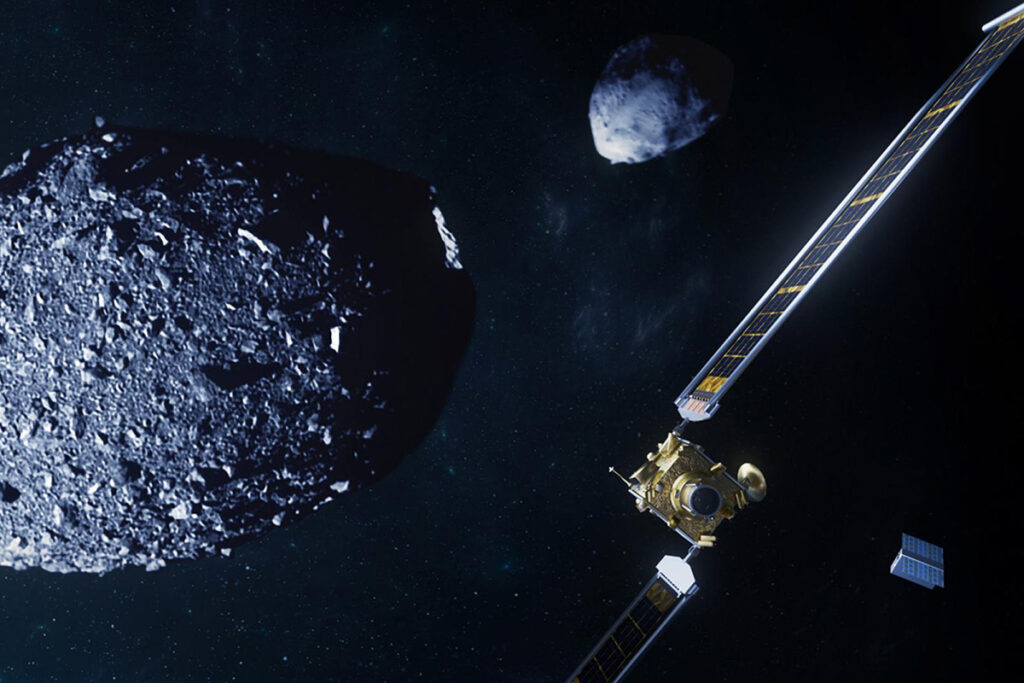
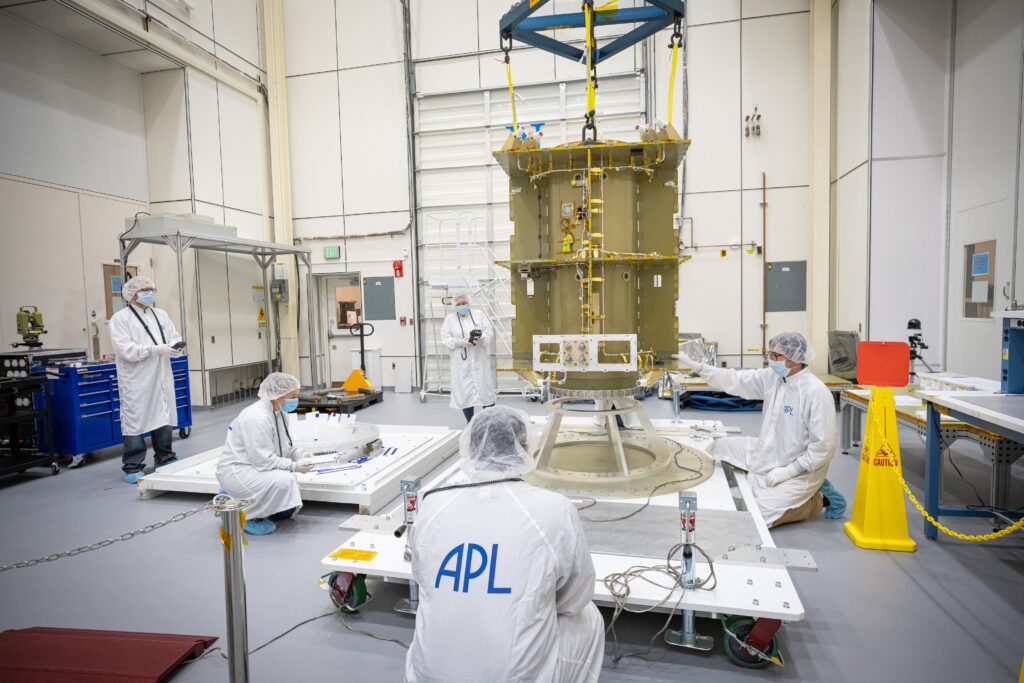
Almost 60 years later, APL is developing technologies to support planetary defense. Between 2017 and 2023, the Lab executed the Double Asteroid Redirection Test (DART), NASA’s first-ever mission to test a method of asteroid deflection by slamming a spacecraft into an asteroid to change its trajectory in space. APL built the DART spacecraft and its single instrument, the Didymos Reconnaissance and Asteroid Camera for Optical navigation (DRACO), which supported the autonomous optical navigation for the spacecraft and captured photos of the target asteroid and the system it’s a part of.
In 2022, the DART spacecraft intentionally collided with the asteroid, successfully demonstrating a mitigation technique that could be used to deflect asteroids that pose a threat to Earth in the future.
“We are charting the course for how to go from where we are right now to being in a place where we are, in fact, ready to respond any day to an asteroid impact threat,” said Terik Daly, planetary scientist and Planetary Impact Laboratory manager at APL. “We are actually bringing together stakeholders from across government, in a way that only a place like APL can, to map out what the challenges are in order to have an effective response.”
Now, the next step is finding asteroids that could threaten Earth, which NASA’s NEO Surveyor will set out to do when it launches in 2027.
AI to enhance sports
The Johns Hopkins Sports Analytics Research Group is leading real-world sports applications of AI, from developing computer-vision systems that precisely measure baseball bats for the Baltimore Orioles to predictive models that identify hidden player value and optimize game strategy. By combing through troves of data and extracting insights, AI is starting to affect how sports are played and coached while also providing data that could help teams support better player safety.
“We’re going from data to information to knowledge to actionable wisdom thanks to AI,” said Anton Dahbura, executive director of the Johns Hopkins University Information Security Institute and co-director of the Johns Hopkins Institute for Assured Autonomy.
It’s also starting to change the sports experience for fans through real-time game information. In the future, Dahbura sees opportunities to use AI to discover new strategies to optimize player performance and measure effectiveness.
“We’re starting to see the impact of AI and other forms of analytics in baseball, but I’m really excited about future opportunities in other sports [with] more continuous flow like basketball, soccer, hockey, and others,” Dahbura said.
Featured experts
-

-

Anton Dahbura
Associate research scientist
Learn More
Co-director of the Johns Hopkins Institute for Assured Autonomy
Executive Director of the Johns Hopkins Information Security Institute -

-

K.T. Ramesh
Alonzo G. Decker Jr. Professor of Science and Engineering
Learn More
Fellow, Hopkins Extreme Materials Institute -

-

Mike Wolmetz
Program manager for Human and Machine Intelligence in APL’s Research and Exploratory Development mission area
Learn More